
What Does It Mean When a Three-Hour AI Experiment Anticipates a Global Brand Campaign?
My thoughts on the new Levi's Campaign.

Last September, I set myself a constraint. Three hours. No budget. Just AI tools.
I’ve been wearing Levi’s since I was five years old. That’s not hyperbole. That’s a 50-plus-year relationship with a pair of jeans.
When you’ve lived with a brand that long, it’s not just clothing. Its texture. Memory. Posture. It’s the leather patch on the back waistband that you instinctively reach for when checking the fit in the mirror. It’s the quiet, universal ritual of turning around to see how your jeans look from behind.
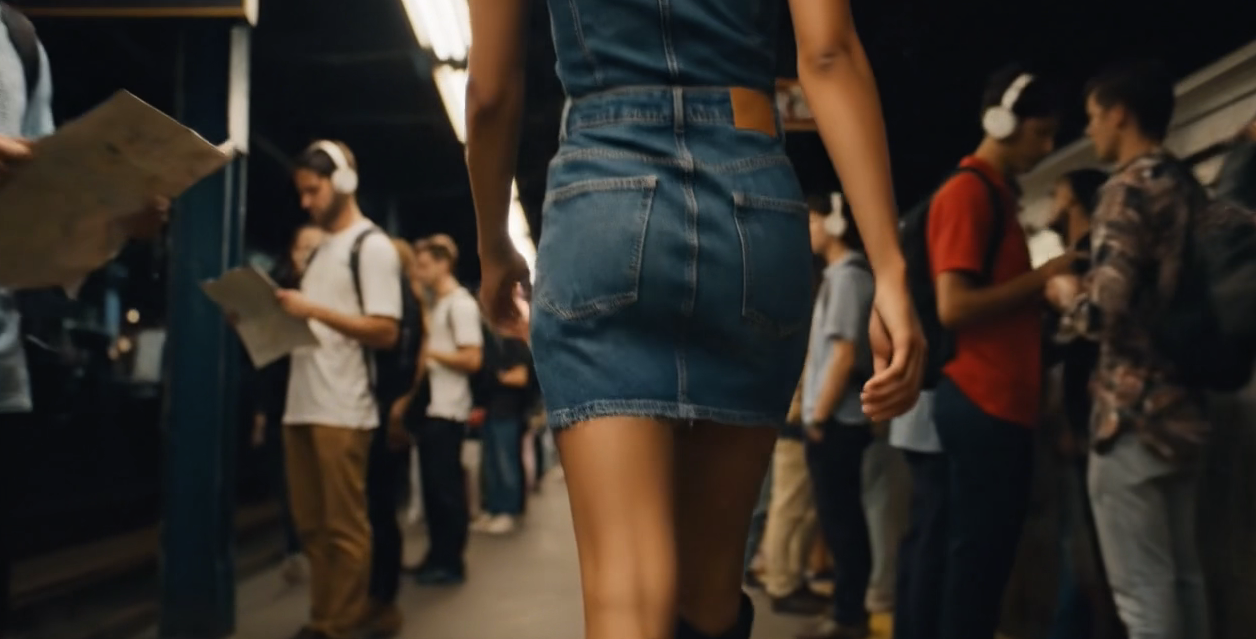
A style for every story.
So that became the experiment.
In three hours, using generative tools, I built a short film around that insight: The celebration of the Levi’s back patch. The celebration of the fit. The celebration of The Butt in Levi’s.
It wasn’t a polished campaign. It wasn’t a client brief. It was a creative workout — a proof of concept for how fast instinct can move when friction disappears.
I posted it on LinkedIn.Then I moved on.
* Levi Strauss & Co. is not a (yet) client of RockPaperScissors. This was a speculative experiment only.
The Speed of Inevitability
About 6 months after my experiment, Levi Strauss & Co. released a new global campaign. And in spirit, it lives in the exact same territory. The back patch. The turn. The celebration of what happens from behind. You may have seen it during Super Bowl LX.
You can watch the ad here.
Within hours after the game, I had five or six messages in my inbox.
“Dude. Levi's copied you.”
I doubt anyone at TBWA\Chiat\Day — the agency behind the campaign — has ever seen my experiment. I am quite certain that Kenneth Mitchell (Global CMO at Levi's) has never heard of me.
But that’s not the point. The interesting question isn’t whether someone copied anyone.
What does it mean when a three-hour AI experiment anticipates a major brand campaign?
There are only a few possible answers.
Coincidence.
Great creatives converge on strong brand codes.
When you understand a brand deeply enough, certain ideas are simply inevitable.
Levi’s has always been about the rear view. The back pocket stitching. The red tab. The leather patch. The silhouette. The attitude of someone walking away.
Those aren’t new ideas. They are embedded in the brand DNA. If you’ve worn the product for decades, or half a century, like I have, those codes live in you. AI didn’t invent that instinct. It just allowed me to express it immediately.
When the Tools Change,
the Tempo Changes.
I wasn’t trying to predict Levi’s next move. I wasn’t trying to reverse engineer a Super Bowl campaign. I was simply following an intuitive brand truth I’ve carried since childhood.
AI let me test it in three hours. That’s the shift. Not replacement. Not automation.
Acceleration.
When you remove friction, instinct surfaces faster. When you remove cost barriers, exploration becomes cheap. When exploration becomes cheap, creative confidence compounds.
This is not a post about who did it first. It’s a post about what becomes possible when the tools change. Six months ago, I could prototype a fully formed brand territory in an afternoon.
Six months later, one of the world’s most iconic brands lands in the same place — with scale, craft, and global distribution. And a great, and expensive, soundtrack.
That convergence is fascinating. It suggests something important: Great brands orbit a finite number of emotional truths.
The better you understand those truths, the more predictable — and prototype-able — their future becomes.
